
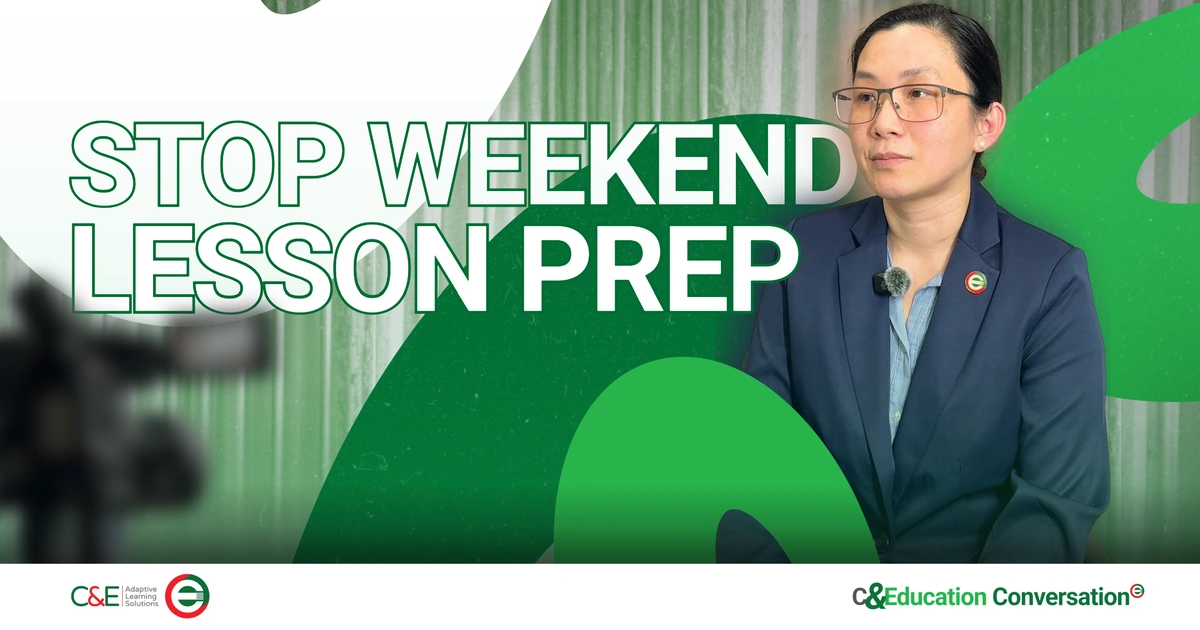

Kite 3.0: AI-Powered Learning Content for Basic Education | Eloisa Chin
Interview with Eloisa Chin
Featured edtech leader
Eloisa Chin
Assistant Vice President for Product Marketing & Customer Success at C&E Adaptive Learning Solutions. She leads the rollout and academic integration of Kite 3.0 for Academy and Basic Education, helping schools across the Philippines reimagine learning through curriculum-aligned, AI-assisted instructional systems.
Rapid-fire takeaway
“The goal is not for AI to create the lesson and the teacher to simply accept it. The goal is to give the teacher a strong starting point, something that they can review, contextualize, and improve based on their learners.”
- Giving weekends back
- Teacher in command
- Data without policing
- NAVIGATE framework
About this conversation
Teachers do not need another dashboard to monitor. They need an instructional system that cuts invisible preparation time, keeps learning curriculum-aligned, and keeps the teacher firmly in charge of the classroom.
In this rapid-fire conversation from the C&Education Conversation Series by C&E Adaptive Learning Solutions, Eloisa Chin, Assistant Vice President of Product Marketing & Customer Success, explores how Kite 3.0 is transforming Academy and Basic Education in the Philippines.
Guided by the theme “Learning Reimagined with AI,” she breaks down why real AI transformation must begin with a concrete teaching bottleneck rather than technology hype. From saving hours of weekend lesson drafting to deploying learning analytics without creating surveillance dashboards, this conversation offers practical, actionable clarity for school heads, academic coordinators, and classroom educators.
Key takeaways
-
1
Tackle teachers' invisible workload in planning and prep Teachers spend extensive weekend hours building lessons from scratch. Kite 3.0 shortens that process by embedding curriculum-aligned C&E content and AI drafting tools into the teacher's daily workflow, giving weekends back to educators.
-
2
AI provides the starting point; the teacher provides context The goal is never for AI to generate lessons for passive delivery. Kite 3.0 creates a solid, aligned foundation that educators review, adapt, and enrich with professional judgment for their specific learners.
-
3
Use data to understand learning, not to police classrooms Schools should not monitor every click simply because technology permits it. Kite 3.0 analytics highlight competency gaps, students needing support, and concepts to reteach, while strictly preserving privacy.
-
4
Start with a specific learning problem, not every AI feature Responsible EdTech adoption means avoiding feature overload. School leaders should identify one urgent instructional challenge, test with a focused teacher cohort, measure clear metrics, and scale purposefully.
-
5
Navigate: Discover, align, activate, sustain C&E ALS has the Navigate program, with four key stages: Discover, align, activate, sustain. Together with the school, we understand their needs, identify where AI adds value, then implement it purposefully.
Topics covered
- Kite 3.0 LCMS
- AI in Basic Education
- Teacher Workload Reduction
- Curriculum-Aligned Content
- Lesson Planning & Prep
- Classroom Learning Analytics
- Data Privacy & Ethics
- NAVIGATE Framework
- Teacher Empowerment
- C&E Adaptive Learning Solutions
- School Leadership & Strategy
Discussion guide
- Where the time goes: planning, content, activities, and assessments
- A starting point, not a finished lesson: giving some of the weekend back
- Use data to understand learning, not to police teachers or learners
- Start with one real problem, not every AI feature
- Navigate: Discover, align, activate, sustain
Transcript
Read the full interview
00:16 If I had to choose, I would say planning and teachers spend significant time preparing lessons, looking for appropriate content, creating activities, developing assessments, and making sure everything is aligned with what students are expected to learn. Now, KITE 3.0 is intended to shorten that process by bringing curriculum-aligned C&E content and AI-assisted tools into the teacher’s workflow.
00:39 The goal is not for AI to create the lesson and the teacher to simply accept it. The goal is to give the teacher a strong starting point, something that they can review, contextualize, and improve based on their learners. So, if a teacher normally spends part of their weekend starting from a blank page, success for us means KITE 3.0 helps reduce that preparation time and give some of that weekend back to our teacher.
01:08 The principle is simple. Use data to understand learning, not to police teachers or learners. A school doesn’t need to monitor every click simply because technology makes it possible. Data in KITE 3.0 should help schools identify learning gaps, students who may need support, and competencies that may need reteaching. But data is only a starting point. Teachers provide the context and professional judgment, while schools ensure appropriate data privacy and access. Learning analytics should help teachers see where support is needed, not turn the classroom into a surveillance dashboard.
01:42 The first step is not to activate every AI feature as much as we’re tempted to click all of those shiny new buttons. It is to identify one real teaching or learning problem that AI can help solve. Then start small. Start with a use case, select a group of teachers, establish what success looks like. We can provide training, use KITE 3.0 for that specific purpose, and review the results.
02:12 That is why C&E ALS has the Navigate program, which helps our partners choose the right learning solutions to learning success. There are four key stages in the Navigate program. Discover, align, activate, sustain. Together with the school, we understand their needs, identify where AI adds value, then implement it purposefully. Learning reimagined with AI means starting with a learning problem, not a technology.
Continue the conversation
Want to discover how Kite 3.0 and the NAVIGATE program can streamline lesson preparation and empower teachers at your school? We'd love to connect.